AI Search Optimization Services: Scope and Pricing
Aug 17, 2026 · 6 min read
Engine coverage is what sets the scope and the price of this work. Here is how the two connect, and what a quote should break into.
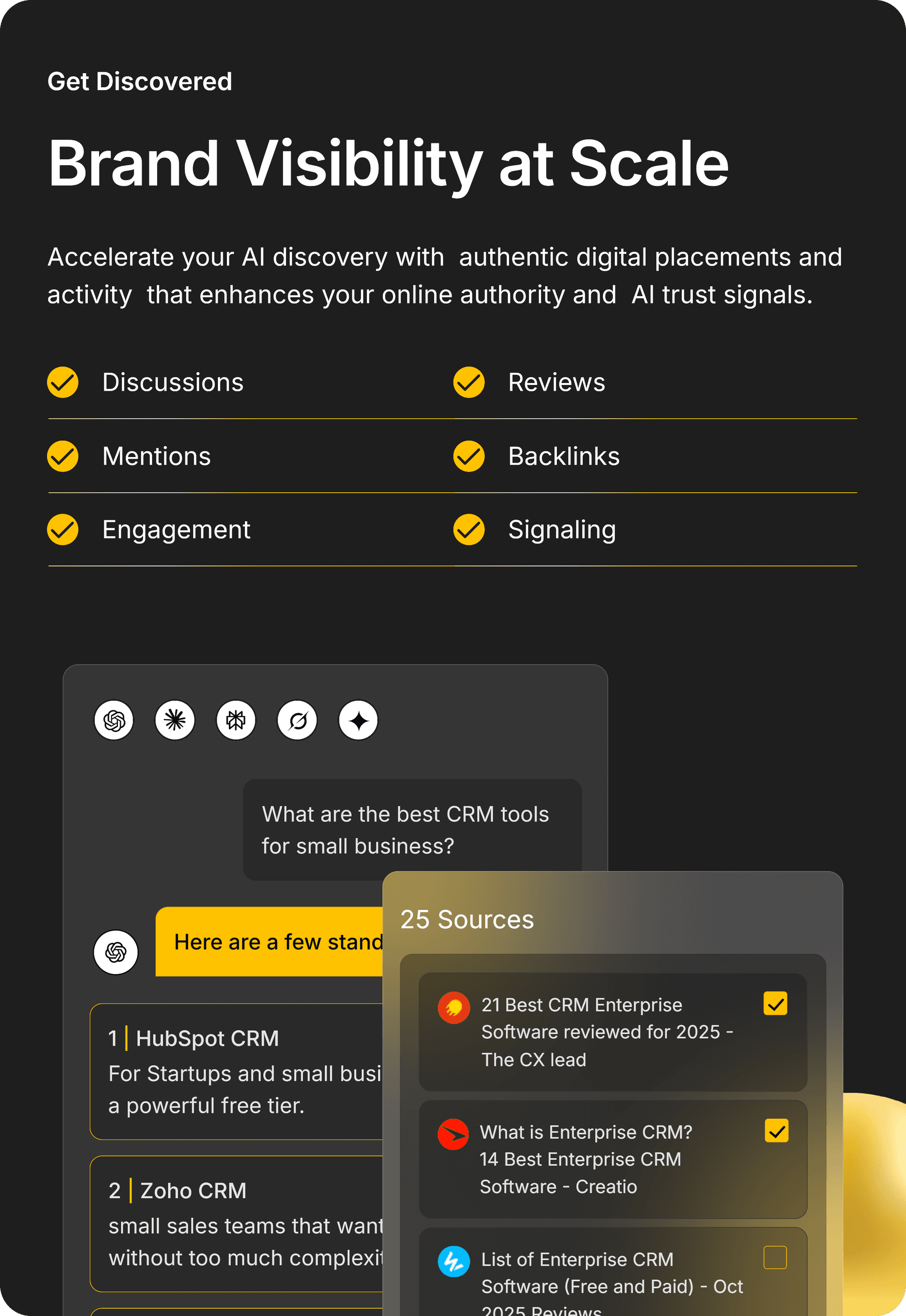
AI search optimization services get your brand into the sources that AI assistants read, then track whether the answers change. The assistants you need determine almost everything about the scope because engines that browse the live web respond to different work than engines relying on trained recall.
Engine behavior below was checked in August 2026.
Key Takeaways
- Coverage sets the price: each additional engine adds publishing surface and tracking surface, and quotes that ignore this are quoting a template.
- Browsing and recall are different jobs: fresh third-party publishing moves one quickly and the other slowly.
- Off-site carries the weight: your own site is a real lever and the smaller one.
- Contrarian: covering every engine is usually the wrong scope. Two engines your buyers use beats six they do not.
- Pricing models are not equivalent: flat retainers, scope-based quotes, and performance deals fail in different places, and one of them fails badly.
What Is AI Search Optimization?
AI search optimization is the work of getting named, described accurately, and cited when assistants answer questions in your category.
It splits into three activities: research into which questions matter and which sources answer them today, publishing into those sources, and measurement across engines on a fixed cadence. What actually drives inclusion in an AI answer is mostly third-party evidence, which is why the work lands off your own domain.
An insurtech platform shows the shape well. Its buyers ask assistants to compare carriers and brokers before any vendor site gets opened, and the comparison gets built from sources the platform does not own.
Which Engines Are Covered
Assistants fall into two behavior classes, and the class matters more than the brand name. The table below compares five common examples across those two classes.
| Engine | How it answers | Shows sources | What moves it | Typical cadence |
|---|---|---|---|---|
| ChatGPT | Trained recall, with web search when the question calls for it | When it searches | Broad corroboration, then fresh sources | Slow, then faster |
| Perplexity | Retrieval-first on every answer | Yes | Fresh, well-ranked third-party pages | Fast |
| Google AI Overviews and AI Mode | Retrieval over Google's index | Yes | Pages and threads that already rank | Medium |
| Claude | Trained recall, with web search when enabled | When it searches | Corroboration across independent sources | Slow |
| Copilot | Retrieval grounded on Bing results | Yes | Coverage indexed by Bingbot | Medium |
Sources for the two rows most often misunderstood: OpenAI states that "ChatGPT will choose to search the web based on what you ask" and returns "links to relevant web sources", so browsing is conditional rather than constant. Microsoft states that "Copilot Search is grounded on Bing search results", which is why a page outside Bing's index is invisible there no matter how it ranks in Google. Checked August 2026.
Retrieval-first engines react to something published last month. Recall-led engines do not, and no honest provider will promise you movement there inside a quarter. Any AI search tracking tools you buy should cover the engines your buyers use rather than the longest list on the pricing page.
Check what the list costs, too. It is normal in this category for the headline plan to include four engines and to bill Claude, Gemini, and Google AI Mode as paid add-ons ranging from $9 to $439 per month, depending on the tier. A six-engine claim is often a four-engine plan with two invoices attached.
Scope of Work and Deliverables
Scope follows from the engine list, then from category competition.
- Prompt set: 20 to 60 buying questions, written as buyers phrase them, one baseline per engine.
- Source-gap map: which pages, threads, and reviews the engines cite for your category, and where you are missing from them.
- Publishing: 6 to 20 pieces a month across communities, review platforms, contributed articles, and listicles.
- Measurement: the same prompts, same engines, same cadence, with sources named against every movement.
Two engines and a narrow category sit at the lower end of those ranges. Five engines across two languages will generally require a scope beyond the upper end.
Pricing Models Explained
| Model | How it is quoted | Works when | Fails when |
|---|---|---|---|
| Flat retainer | One monthly fee, fixed output | Scope is stable | Your category needs a surge |
| Scope-based | Priced per engine and per output volume | You want to control cost precisely | Scope changes monthly |
| Performance-linked | Base fee plus a bonus on tracked movement | Both sides trust the measurement | The metric is gameable |
Performance-linked deals are the ones to read closely. Mention rate can be moved by publishing into low-value sources nobody reads, so a bonus tied to it rewards volume over judgment. If you want a performance component, tie it to citation rate on a fixed prompt set with named sources.
On-Site vs Off-Site Work
On-site work earns its place and then stops earning.
What your site genuinely does: states your category clearly, answers the obvious questions in extractable form, and keeps crawlers unblocked. Structuring pages for machine consumption rather than for scanning is real work with a real return.
Where it stops: an assistant assembling a shortlist reads what other people wrote about your category. Your page is one source among many, and it is the one the model trusts least, because you wrote it.
Expect roughly one part on-site to four parts off-site in a mature program. Teams arriving from SEO usually have that ratio inverted.
Reporting and Measurement
Four numbers, in the order they move: mention rate, citation rate, share of voice against named rivals, then sentiment.
Good AI search monitoring names sources. A mention count with no source list cannot be audited and gives you nothing to do next. Ask any provider to show you a report that connects a movement to the specific threads or pages the engine cited.
Configure assistant referral tracking in month one, because AI referrals behave as their own traffic source and retrofitting the data later is not possible.
Timeline to First Results
Sixty to ninety days to a defensible reading.
Retrieval-first engines can show movement inside 30 to 45 days when a published asset ranks quickly. Recall-led engines take longer and sometimes take model updates. Anyone quoting a single timeline across every engine has not thought about the difference.
Month one produces research. Month two produces published assets and may show early movement in retrieval-first engines. Month three is usually the first honest comparison against the baseline.
How Klarivo Scopes AI Search Optimization
Klarivo scopes from the engine list backwards. The prompt set gets built for the assistants your buyers actually use, and the publishing plan is sized to that, rather than to a package tier.
Klarivo Monitor covers five answer engines: ChatGPT, Claude, Perplexity, Gemini, and Grok. Each is tracked independently, on a schedule you set, so you can see platform-specific gaps rather than one blended score. All five are included rather than sold as per-engine add-ons, which is the detail worth comparing against any quote that leads with a coverage count.
The reporting side runs in Klarivo Monitor, which re-runs the prompt set on a fixed cadence and names the sources behind each movement. The publishing side operates community and third-party presence at volume, which is the part most teams cannot staff.
If your buyers only use one assistant, say so early. It is a smaller engagement and a cheaper one, and pretending otherwise would be the easiest way to oversell this.
Want a scope sized to your category rather than to a tier? Get your AEO Fit Check. Eight questions, an instant fit score, no demo gate. Tracking runs in Klarivo Monitor.
FAQ
Do you have to optimize for every engine, or can you pick two?
Pick two, in most cases. Coverage costs money on both sides of the work, and the engines your buyers use are usually a short list. Run a baseline across five, see where your category conversations actually happen, then scope to the ones that matter.
What happens to the work when a provider changes its retrieval model?
The published assets keep their value, because a well-regarded thread or review stays useful across updates. Tracking often needs reconfiguring, sometimes within a week. This is a real exposure in the category and nobody has solved it.
Can easy-to-use AI search optimization software replace a service engagement?
Only if you already publish off-site every week. Software tells you where you stand and does not write anything. Teams with publishing capacity should buy the software and skip the service. Teams without it will renew a subscription for a year and see the same chart.
How is this different from what an SEO agency already does for you?
The research overlaps and the execution does not. SEO work optimizes assets you control. This work builds evidence on sources you do not, and measures a surface that has no ranking positions to report. Most SEO agencies have not built the contributor capacity to do it.
Can you run this for a brand that has no search presence yet?
Yes. The work can be strategically simpler because a new brand has no legacy misdescription to correct. However, building third-party coverage from scratch can take longer than improving an existing footprint and costs approximately the same.
Start accelerating your Reddit presence
See how Klarivo can shift your visibility across AI, search and buyer communities.
Book a Demo